.png)
The DIZ Zurich publishes annual reports on the substances analyzed. This report summarizes the findings for substances that were analyzed separately in 2025, thereby supplementing the annual analysis of the most commonly dispensed substances. Figures from the previous year are shown in parentheses. The results published here are not representative of the entire substance market in the city of Zurich.
In 2025, 198 samples declared as ketamine were analyzed at the DIZ Zurich and during 9 mobile drug testing events (189). The average active ingredient content was 92.5% (92.3%). Additional psychoactive substances were detected in 6 samples, including caffeine, 2C-B, phenylethylamine (2-PEA), and, in one case, a mixture of cocaine, procaine, and caffeine. In about a quarter of the cases, the drugs were obtained through online channels.
Among the mislabeled substances identified in 2025, an unusually high number were other dissociatives with a similar spectrum of effects to ketamine—including methoxetamine and 2-oxo-PCE. Other mislabeled substances contained cocaine, amphetamine, or the cathinone 3-CMC. Five samples contained no psychoactive substances.
In 2025, 110 samples identified as 2C-B were analyzed (84). Fifty-nine samples were submitted as powder/crystals, and 49 as 2C-B pills. The pills contained an average of 14.7 mg of 2C-B per pill (12.7 mg), ranging from 7.1 to 25.2 mg of 2C-B.
Synthesis impurities were detected in 23 of 110 samples (21%), predominantly in powder samples. Three powder samples contained at least six synthetic impurities, indicating improper synthesis or purification. Two samples were found to be mislabeled, containing no psychoactive ingredients, and one sample contained only lidocaine.
In 2025, 195 samples declared as cathinones were analyzed at the DIZ Zurich and at 9 mobile drug-checking sites. The most common substances identified were 4-MMC (mephedrone) and 3-MMC, followed by 2-MMC, 3-CMC, 4-CMC, and a few other cathinones.
In 89.2% of the samples purchased as 3-MMC, no 3-MMC was detected. The most common substitute substance found in these samples was 2-MMC (2-methylmethcathinone), followed by 4-MMC, 3-CMC, and 4-CMC. In some samples, only methamphetamine, cocaine, MDMA, or α-PVP were detected instead of 3-MMC. The sale of 2-MMC instead of 3-MMC is likely due to economic and regulatory reasons: 3-MMC has been subject to EU narcotics laws since 2022, while 2-MMC is cheaper and more readily available. However, the substances differ in their pharmacological profiles: 2-MMC has a stronger stimulant effect and is less empathogenic than 3-MMC, which can lead to the expected effects not materializing and may prompt users to take additional doses. In the first half of the year, 80.6% of the 3-MMC samples were mislabeled; in the second half of the year, the figure was 100%.
For 4-MMC, 69 out of 111 samples (62%) in 2025 contained only the declared active ingredient. In 14 samples, other psychoactive substances were detected in addition to 4-MMC—most commonly 4-CMC and 2-MMC, and in some samples also MDMA, cocaine, or amphetamine. In 28 samples (25%), the product was mislabeled with no detectable 4-MMC. Most commonly, 2-MMC and 4-CMC were sold as 4-MMC; in some samples, only methamphetamine, MDMA, ketamine, or NEP (N-ethylnorpentedrone) was detected.
Since it is currently impossible to be certain that you will receive the desired substance when purchasing cathinones—particularly 3-MMC—it is especially important to have the substance tested before use. If drug testing is not possible, you should at least start with a small dose the first time you use it and wait to see how it affects you before taking another dose.
In 2025, 84 samples identified as heroin were submitted (36). This increase is attributable, among other things, to the growing use of drug testing services in consumption rooms.
The average active ingredient content was 26.6%. Paracetamol and caffeine were typically present in nearly all samples as cutting agents and flow agents. MDMA was also detected in one sample. In addition, three samples contained no detectable active ingredient of heroin: two of these consisted of paracetamol, caffeine, and poppy plant byproducts, while one sample contained only cocaine.
In 2025, 80 samples declared as methamphetamine were analyzed (59). The average purity was 95.4% (97.2%), remaining high. Compared to the previous year, which recorded no cutting agents, caffeine, the cathinone 2-MMC, and a synthetic impurity were each detected in one sample in 2025.
In 2025, 46 samples declared as psilocybin were submitted, both in concentrated liquid form and as dried plant material. In 9 liquid samples, only 4-HO-MET and/or 4-AcO-DMT were detected as misdeclarations: these are semisynthetic tryptamines with a similar spectrum of effects to psilocybin. No psychoactive substances were detected in 2 other samples.
In 2025, 43 samples declared as containing mescaline were submitted, mostly plant material grown by the submitters themselves or obtained from private sources. The average mescaline content was 30.1% (range: 0.3–98%). More than half of the samples contained less than 10% mescaline, which is typical for plant-based preparations.
In addition, 18 samples declared as DMT/Changa were tested at the DIZ Zurich. DMT was detected exclusively in 14 samples; in 5 samples, additional substances were analyzed, including N-methyltryptamine (NMT), and in one sample, the naturally occurring harmin and harmaline. In 3 samples, only harmin was detected without DMT—possibly Ayahuasca components in which the DMT content was not detectable. In one sample, at least 5 synthetic impurities were identified, including NB-DMT. One crystalline sample contained only MDMA (mislabeling).
In 2025, 26 samples were sold as GHB/GBL (20 declared as GHB, 6 as GBL). Eight of the 20 GHB samples contained no GHB: six of these contained only GBL, one sample contained 1,4-butanediol (BDO), and one sample contained no psychoactive substances. GBL and BDO are so-called "prodrugs" of GHB; they are dosed at lower levels than the intended GHB, and their effects set in more quickly. Consequently, the risk of overdose is correspondingly higher in cases of mislabeling.
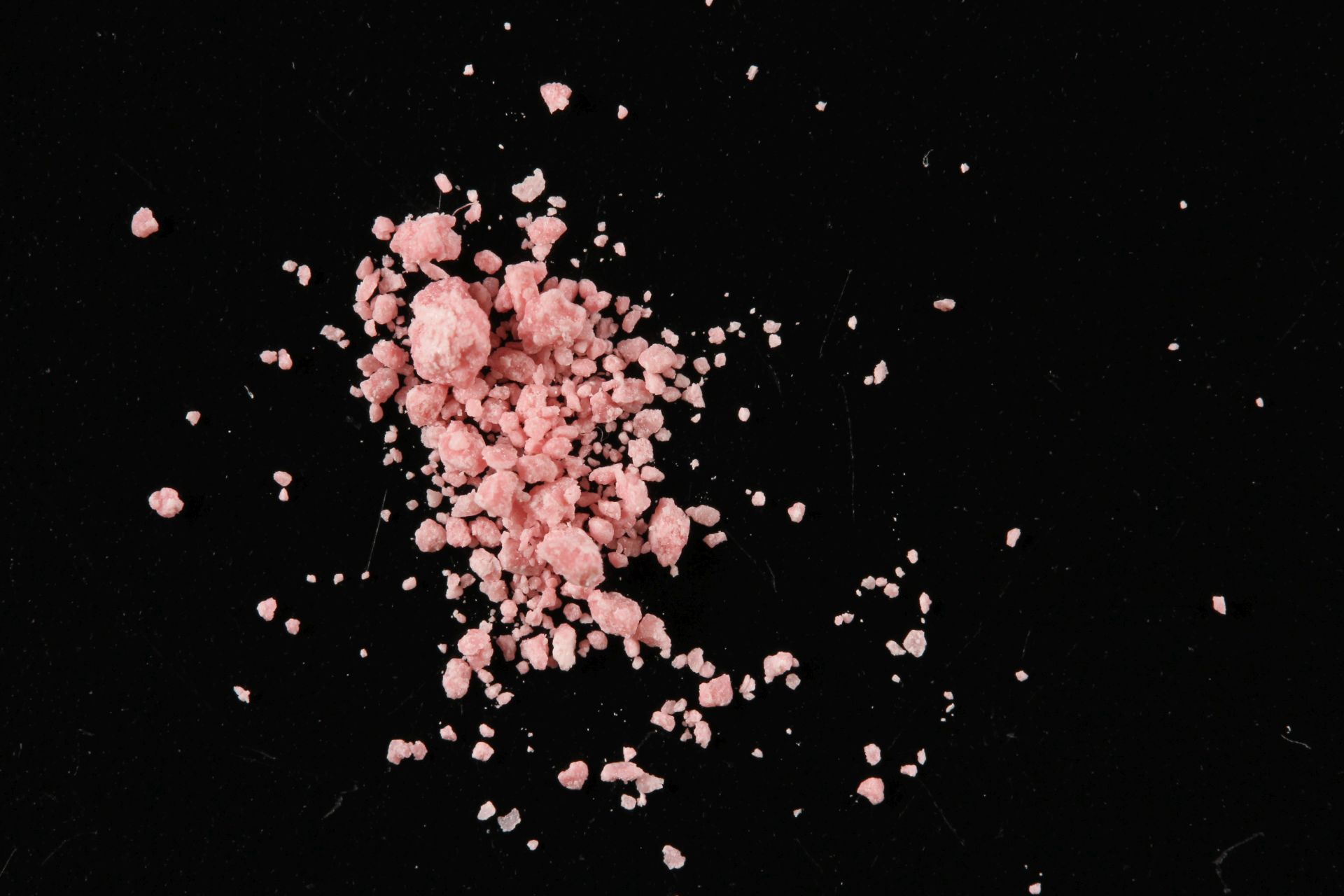
In 2025, 20 samples labeled as “Tusi” or “Pink Cocaine” were submitted to the DIZ Zurich or at mobile drug testing sites (13). Tusi is a pink-colored powder mixture that typically contains ketamine and MDMA. Only 4 of the 20 samples contained exclusively ketamine and MDMA; in the remaining samples, additional psychoactive substances were analyzed.
The most frequently detected additional substance was 2C-B, a potent psychedelic, which was detected in 5 samples. Caffeine was present in 6 samples, and acetaminophen in 3. Ketamine was completely absent in two samples, and one sample contained no MDMA. Synthetic impurities and unknown compounds were detected in some samples. The composition varied considerably between samples, which makes a reliable dose estimation significantly more difficult.
In 2025, 47 illegally obtained medications were submitted for analysis. As in previous years, the 2025 analysis results show that illegally obtained medications mostly contain ingredients other than those declared at the time of purchase.
Alprazolam (Xanax®) was the most frequently declared medication, with 18 samples. Six samples contained no psychoactive substances, and five others contained a different benzodiazepine—including oxazepam, lorazepam, and N-desalkylflurazepam. Samples of diazepam, lorazepam, and midazolam predominantly contained the declared active ingredient. Compared to 2024, when approximately two-thirds of the alprazolam samples contained the declared active ingredient, the hit rate in 2025 has deteriorated significantly once again.
Of 6 codeine samples, only one contained exclusively the declared active ingredient. The remaining samples turned out to be mislabeled, containing tramadol, diphenhydramine, or ketamine as the active ingredient. Among the oxycodone samples, 2 out of 4 contained the declared active ingredient, while one sample contained the highly potent N,N-dimethylamino etonitazene.